
The Plastic Pollution Crisis Is Also a Financial Crisis
A plastic pollution budget fix isn’t just an environmental goal — it’s an urgent economic one. Right now, plastic pollution costs the global economy anywhere from $500 billion to $2.5 trillion every single year. That includes damage to fisheries, lost tourism revenue, healthcare costs, and the slow destruction of marine ecosystems.
Here’s a quick breakdown of the key fixes — from personal to policy level:
| Level | Action | Estimated Impact |
|---|---|---|
| Global policy | Extended Producer Responsibility (EPR) | Shifts costs from taxpayers to producers |
| Global policy | Fee on virgin polymers ($60-90/tonne) | Closes $350-500B financing gap for developing nations |
| National/state | Single-use plastic bans and legislation | California’s SB 54 avoids 115M tonnes of CO2e |
| Circular economy | Shift from throwaway to reuse systems | $1.27T in direct savings + $3.25T in avoided costs |
| Household | Switch to reusables, bulk buying, DIY products | Saves money and reduces personal plastic footprint |
The scale of the problem is staggering. Over 11 million metric tonnes of plastic enter the world’s oceans every year — more than a garbage truck’s worth every single minute. And if nothing changes, plastic waste is projected to triple by 2060.
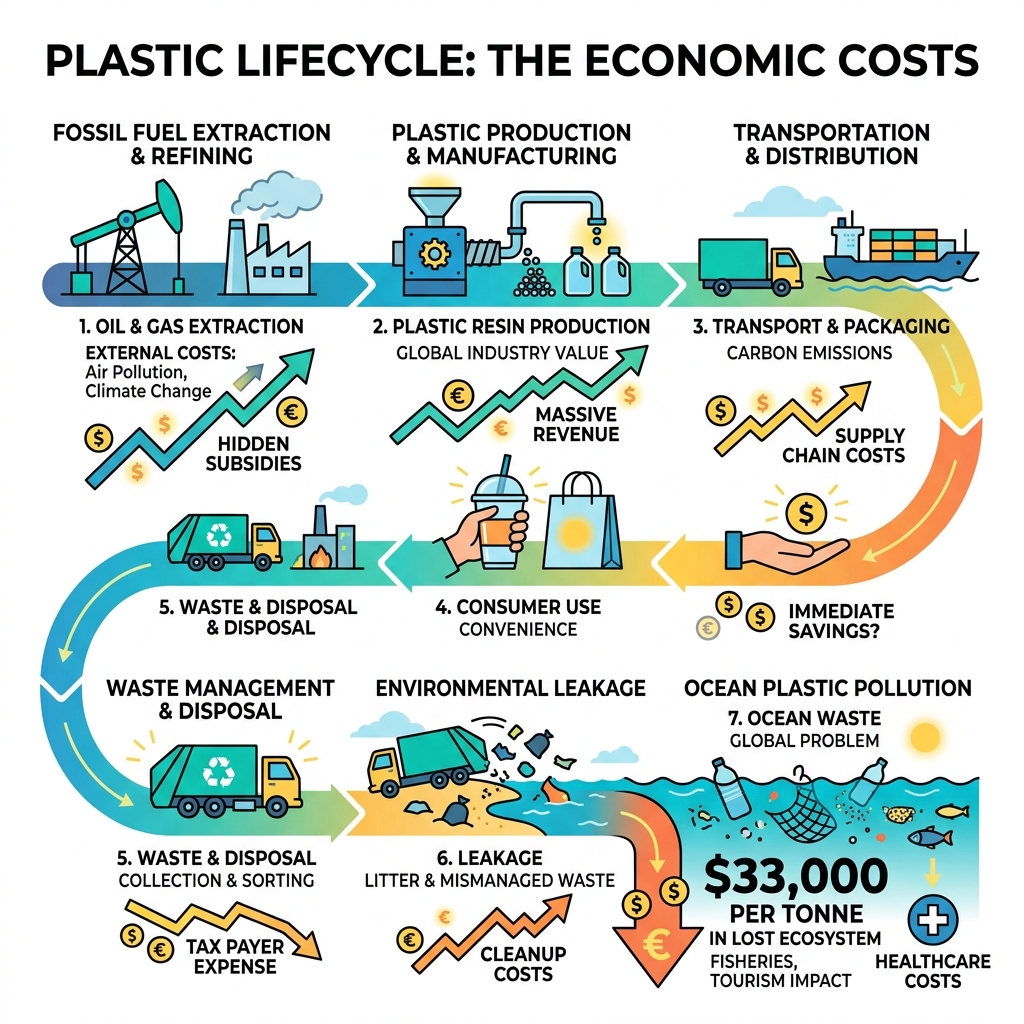
But here’s what often gets missed: this isn’t just a nature problem. It’s a money problem. Every tonne of plastic that enters the ocean costs an estimated $33,000 in lost ecosystem value. Chemicals leaching from plastics racked up an estimated $249 billion in healthcare costs in the US alone in a single year.
The good news? The solutions exist — and many of them actually save money rather than spending it.
Whether you’re a concerned individual looking to cut waste at home or someone who wants to understand the policy levers that could turn the tide, this guide walks through all of it.
The Trillion-Dollar Toll: Why We Need a Plastic Pollution Budget Fix
When we see pictures of sea turtles tangled in nets or beaches covered in bottles, our first instinct is empathy for the environment. But at FinanceZenX, we also look at the ledger. The “environmental” problem is actually a massive “economic leakage.” We are essentially throwing trillions of dollars into the ocean and leaving future generations to pay the interest.
The annual loss to the global economy is estimated between $500 billion and $2.5 trillion. To put that in perspective, every single metric ton of plastic that ends up in our waters carries a price tag of roughly $33,000 in lost marine ecosystem services. These services aren’t just “nice to have”—they are the backbone of global industries.

Fisheries and aquaculture are hit first and hardest. When fish ingest microplastics, it doesn’t just threaten biodiversity; it threatens the livelihoods of millions and the food security of billions. Tourism and recreation follow closely behind. A littered beach isn’t just an eyesore; it’s a direct hit to local revenue, leading to increased cleanup costs and a sharp decline in visitor spending.
Then there is the human health aspect. Plastics are responsible for over $1.5 trillion in health-related economic losses per year. We aren’t just talking about physical injuries to wildlife. For humans, the chemicals used in plastic production—many of which are endocrine disruptors—are linked to staggering healthcare burdens. In the U.S. alone, chemical exposure from plastics cost an estimated $249 billion in 2018. According to Scientific research on the economic impacts of plastic pollution, these costs are only set to rise as production increases.
Quantifying the Hidden Costs of Inaction
If we do nothing, the “business-as-usual” scenario is a financial nightmare. Currently, plastic pollution causes about $75 billion per year in environmental damages, with $13 billion of that tied directly to marine ecosystems. But the costs extend far beyond the shoreline.
Plastic and climate change are inextricably linked. The plastics sector is responsible for 3% to 4% of global greenhouse gas (GHG) emissions. By 2050, if production continues unchecked, plastics could consume 10% to 13% of the entire global carbon budget. This isn’t just a projection; it’s a warning that our current path is incompatible with the Paris Agreement.
Research into Pathways to reduce global plastic waste mismanagement shows that by 2050, GHG emissions from plastics could grow by 37% to 3.35 billion tonnes of CO2 equivalent. The “budget fix” here isn’t just about cleaning up trash; it’s about preventing a climate-driven economic collapse.
Policy Power Plays: Funding Systemic Change
To achieve a true plastic pollution budget fix, we have to move beyond “don’t litter” campaigns. We need systemic shifts that change who pays for the mess. Currently, the public—through taxes and health costs—picks up the tab for plastic waste while producers reap the profits.
One of the most powerful tools in our arsenal is Extended Producer Responsibility (EPR). This “polluter-pays” principle requires companies that manufacture plastic packaging to fund its collection and recycling. This shifts the financial burden from municipal taxpayers to the companies themselves, incentivizing them to design products that are easier (and cheaper) to recycle.
Another innovative proposal is the Polymer Premium. This suggests a global fee of $60 to $90 per tonne on primary (virgin) plastic polymers. While this sounds like a lot, it would only increase the price of plastic by about 5-7%, which translates to less than a 0.1% price increase for consumers. However, it would generate enough revenue to close the $350-$500 billion financing gap needed for developing nations to implement the Global Plastics Treaty.
The UN roadmap outlines solutions to cut global plastic pollution by 80% by 2040, but it requires these fiscal frameworks to be in place. By taxing virgin plastics and investing in infrastructure, we can make recycled materials more competitive and fund the transition to a cleaner economy.
Legislative Action: California’s SB 54 as a Plastic Pollution Budget Fix
We don’t have to wait for a global treaty to see results. Several U.S. states are already proving that legislative action works as a plastic pollution budget fix. California’s SB 54 is a gold standard. This law aims to eliminate 23 million tons of single-use plastics over the next decade. By doing so, it is projected to avoid 115 million tons of CO2e—equivalent to taking 28 coal plants offline.
Other states are following suit:
- Maryland: Their phase-out of foam foodware led to a 65% reduction in foam litter collected by volunteers.
- Washington: “By-request” laws for straws and utensils ensure that plastic isn’t handed out by default, reducing waste and saving businesses money on procurement.
Closing the $500 Billion Financing Gap
The biggest hurdle in the global fight is the financing gap in low- and middle-income countries. These regions often lack the waste management CAPEX (capital expenditure) to handle the flood of plastic coming from international brands.
According to the Introduction to Science-Based Solutions, we must prioritize a “just transition.” This includes formalizing the role of waste pickers, who currently collect 60% of all recycled plastic globally. By integrating these workers into formal systems with better pay and safety, we solve a social crisis while fixing an environmental one.
The Circular Economy: Turning Waste into Wealth
At FinanceZenX, we love a good ROI. The shift to a circular plastics economy offers one of the best returns on investment for the planet. Instead of a linear “take-make-waste” model, a circular system keeps materials in use for as long as possible.
The numbers are staggering:
- $1.27 trillion in direct savings from reduced costs and recycling revenues.
- $3.25 trillion saved by avoiding “externalities” like health, climate, and ecosystem damage.
- 700,000 new jobs created by 2040, primarily in the reuse and recycling sectors.
This isn’t just theory. The report Breaking the Plastic Wave 2025 highlights that we can reduce annual plastic pollution by 83% using existing technologies. The key is resource efficiency—treating plastic as a valuable resource to be recovered rather than a nuisance to be buried.
Redesigning the Future of Packaging
The most effective plastic pollution budget fix is to stop the waste before it’s even created. This means a massive scale-up of reuse and refill systems. Shifting just 13% of single-use packaging to reusable formats could save over $1 billion annually for U.S. taxpayers.
Deposit-return schemes (DRS) have also proven incredibly effective. In Europe, countries with DRS achieve return rates of 85% to 95%. This provides a clean stream of high-quality plastic for recycling, reducing the need for virgin oil-based materials. As noted in Plastic Pollution Is a Major Problem in the U.S., but Solutions Exist, these systems can reduce beverage bottle pollution by 41% almost overnight.
Household Strategies: Saving Money While Saving the Planet
While we push for policy changes, we can implement our own personal plastic pollution budget fix right in our kitchens. Sustainable living isn’t just about “doing good”; it’s about smart financial management.
One of the easiest wins is bulk buying. By purchasing grains, beans, and even cleaning supplies in bulk, you bypass the “packaging tax” that manufacturers build into the price of smaller, plastic-wrapped items. For more tips on this transition, check out our guide on how-to-reduce-plastic-use-at-home.
Another strategy is the DIY route. Making your own cleaning products using simple ingredients like vinegar and baking soda eliminates dozens of plastic spray bottles a year. We’ve found that living-a-zero-waste-lifestyle often leads to a much leaner, more intentional household budget.
Household Savings: Your Personal Plastic Pollution Budget Fix
Let’s talk numbers. The average person uses 156 plastic bottles a year. By switching to a high-quality reusable bottle and filtered tap water, you can save hundreds of dollars annually. We’ve covered many of these zero-waste kitchen hacks that you can diy to help you get started without spending a fortune on “eco-gadgets.”
Repairing is another lost art. Instead of tossing a plastic item when a small part breaks, we advocate for guide-to-making-reusable-household-items. And before you recycle that glass jar, consider creative-ways-to-repurpose-jars-and-bottles for pantry storage or gifts.
Smart Shopping and Waste Reduction
When you do head to the store, look for unpackaged produce. Farmers’ markets are excellent for this, as they rarely use the heavy plastic film found in supermarkets. If you want to reduce-household-waste-effectively, bringing your own bags is a must. We’ve even reviewed reusable shopping bags to help you find the most durable options.
Understanding the “resin identification numbers” on the bottom of containers is also vital. Not all plastic is created equal, and knowing what your local facility actually accepts prevents “wish-cycling,” which can contaminate entire batches of good recycling. For a deep dive into what you can and can’t toss in the bin, refer to the EPA’s guide on What You Can Do to Reduce Plastic Waste.
Frequently Asked Questions
What is the most effective policy for a plastic pollution budget fix?
Extended Producer Responsibility (EPR) and deposit-return schemes are widely considered the most effective as they shift the financial burden from taxpayers to producers and incentivize high return rates. These policies ensure that the cost of disposal is “internalized” into the product’s price, encouraging better design.
How much does plastic pollution cost the global economy?
Estimates range from $500 billion to $2.5 trillion annually when accounting for ecosystem service losses, tourism impacts, fisheries damage, and healthcare costs related to chemical exposure. This is equivalent to roughly $33,000 for every metric ton of plastic that enters the ocean.
Can individual actions really make a difference in the plastic crisis?
Yes. While systemic policy change is vital, individual shifts—such as 1 in 5 people switching to reusable bags—can eliminate 100 billion plastic bags from the waste stream annually. Furthermore, consumer demand for plastic-free options drives the market toward sustainable alternatives and pressures corporations to change their packaging strategies.
Conclusion
The war on plastic isn’t just about saving the whales—it’s about saving our collective bottom line. A systemic transformation of how we produce, use, and dispose of materials is the only way to achieve a lasting plastic pollution budget fix.
At FinanceZenX, we believe that financial wellness and environmental stewardship go hand in hand. By advocating for polluter-pays policies, supporting a circular economy, and making smarter choices in our own homes, we can turn the tide. We can protect our oceans, our health, and our wallets all at the same time.
Ready to take the next step in your sustainable journey? Explore More sustainable living tips to learn how you can live a high-impact, low-waste life without breaking the bank.
