
Why Every Drop You Save at Home Matters
Water conservation at home is one of the simplest and most impactful things you can do to cut your bills, reduce your environmental footprint, and protect a resource that’s under growing pressure.
Here’s a quick snapshot of the most effective ways to save water at home:
- Fix leaks fast – a leaky toilet alone can waste 200 gallons per day
- Upgrade fixtures – low-flow showerheads, faucet aerators, and WaterSense-labeled toilets
- Run full loads – dishwashers and washing machines only when completely full
- Water smarter outdoors – early morning or evening, with drought-tolerant plants and mulch
- Install efficient appliances – ENERGY STAR certified washers and dishwashers
- Collect and reuse water – rain barrels, greywater reuse, and shower warm-up buckets
The average American uses around 170 gallons of water per day. A typical household burns through roughly 150,000 gallons per year — and a big chunk of that is wasted without anyone realizing it.
That’s not just an environmental problem. It’s a money problem.
Headlines about drought, shrinking reservoirs, and tightening water restrictions are becoming harder to ignore. Communities across the American West, Southeast, and beyond are feeling the squeeze — from both a changing climate and surging demand.
The good news? Most of the waste is fixable. And the fixes are often cheap, fast, and surprisingly satisfying.
This guide breaks it all down — indoors, outdoors, and everything in between — so you can start saving water (and money) today.

Why Water Conservation at Home is a Financial and Environmental Win
At FinanceZenX, we believe that eco-friendly living isn’t just a moral choice; it’s a brilliant financial strategy. When we talk about water conservation at home, we aren’t just talking about saving the planet—we’re talking about padding your bank account.
The “Drops & Watts” connection is a concept every homeowner should understand. It takes a massive amount of energy to pump, treat, and heat the water that enters your home. In fact, for homes with electric water heaters, about one-quarter of the entire electric bill goes toward heating water. By using less water, you aren’t just lowering your water bill; you’re slashing your energy costs too.
Consider the potential for Start Saving by looking at the numbers. The average American family spends about $1,300 annually on water costs. However, by retrofitting your home with WaterSense labeled fixtures and ENERGY STAR certified appliances, you can save roughly $500 per year. That is a 38% reduction in your utility costs!
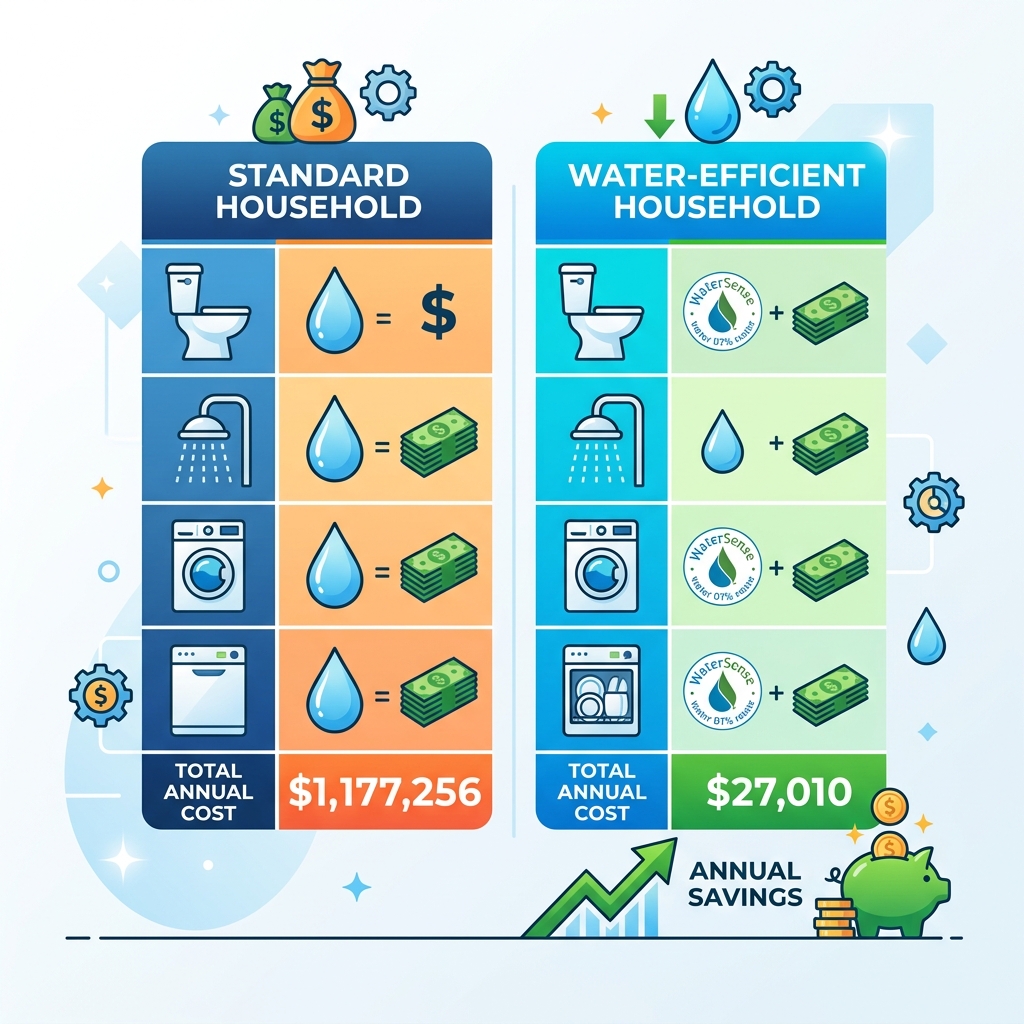
Beyond the direct savings, thoughtful-daily-water-saving-strategies contribute to long-term financial wellness. By reducing demand on municipal systems, we help delay the need for expensive new water infrastructure, which ultimately keeps local taxes and utility rates lower for everyone. It’s a win-win for your wallet and your community.
Indoor Efficiency: Maximizing Every Gallon
Indoor water use is where we have the most direct control over our daily habits. To master water conservation at home, we first need to understand where the water goes. A typical household requires about 0.4 to 0.5 acre-feet of water annually (roughly 150,000 gallons) to satisfy both indoor and outdoor demands.
The first step in any indoor strategy is leak detection. Did you know that faucet leaks contribute to about 900 billion gallons of wasted water every year in the U.S.? That is enough to supply 11 million households! A simple way to find “silent” leaks is the food coloring test: drop a little food coloring into your toilet tank. If the color appears in the bowl within 30 minutes without flushing, you have a leak that needs fixing.
For more comprehensive advice, check out these water-usage-reduction-tips to help you audit your home’s efficiency.
Mastering Water Conservation at Home in the Bathroom
The bathroom is the “water hog” of the house, accounting for over 50% of all indoor water use. The toilet alone represents about 28% of a home’s indoor usage. If you are living in an older home, your toilet might be using 3.5 to 7 gallons per flush (gpf). Switching to a high-efficiency WaterSense model (1.28 gpf or less) can save a family of four between 14,000 and 25,000 gallons per year.
If you aren’t ready for a full replacement, consider these lowering-bathroom-water-usage tactics:
- Install Faucet Aerators: These tiny, inexpensive mesh screens can reduce faucet water flow by 30% or more without you even noticing a difference in pressure.
- Shorten Your Showers: Aim for 5 minutes. Reducing your shower time by just one minute can save gallons every single day.
- Turn Off the Tap: Whether you’re brushing your teeth or shaving, keep the water off until you actually need to rinse. Brushing your teeth with the tap running can waste 4 gallons in just two minutes.
- Dual-Flush Retrofits: You can install kits that allow for a “half-flush” for liquid waste, significantly cutting down on daily toilet water use.
Kitchen and Laundry Room Efficiency
The kitchen and laundry room are the next frontiers for water conservation at home. Modern technology has made it much easier to be efficient here, especially if you look for the ENERGY STAR label.
In the kitchen, the biggest surprise for many is that using a dishwasher is actually more water-efficient than hand washing—provided you run it with a full load. Modern ENERGY STAR dishwashers use about 3.5 gallons per cycle, whereas hand washing the same amount of dishes can use up to 27 gallons.
To further your cutting-down-on-kitchen-water-waste, try these habits:
- Scrape, Don’t Rinse: Don’t pre-rinse dishes before putting them in the dishwasher. Modern detergents and machines are designed to handle food particles.
- Compost Instead of Grind: Garbage disposals require a lot of running water to operate. Composting your food scraps is much better for your pipes and the environment.
- The Fridge Pitcher: Instead of running the tap until the water gets cold, keep a pitcher of drinking water in the refrigerator.
In the laundry room, the shift from conventional top-loaders (which use 35-50 gallons per load) to front-loading ENERGY STAR washers (which use 18-20 gallons) is a game-changer. Always wash full loads, and use the cold water setting whenever possible to maximize energy savings. For more detailed steps, visit How To Save Water.
Outdoor Strategies for a Water-Wise Landscape
Outdoor water use is where household consumption can truly skyrocket. Nationally, about 30% of residential water is used outdoors, but in hot summer months or dry climates, that number can jump to 70%. In many urban areas, over half of the residential water supply goes toward maintaining turf grass.
The most effective way to achieve water conservation at home outdoors is through “Xeriscaping” or water-wise landscaping. This doesn’t mean you have to have a yard full of rocks and cacti. It means choosing plants that are native to your region and grouping them by their water needs. You can find excellent regional resources at Conserve Water | Bureau of Reclamation.
One of the best-kept secrets of a healthy garden is mulching. Applying a thick layer of mulch around your plants can reduce soil evaporation by as much as 50%. This keeps the roots cool and moist, meaning you have to water much less frequently.
Smart Irrigation and Maintenance
If you do have a lawn or garden that requires watering, efficiency is key. A “Sprinkler Spruce-Up” should be an annual tradition. Check for broken heads, misdirected spray (don’t water the sidewalk!), and leaks in the lines.
- Drip Irrigation: For garden beds and shrubs, drip irrigation is far superior to sprayers. It delivers water directly to the roots, reducing waste by up to 15% compared to traditional systems.
- Soil Moisture Checks: Before you turn on the hose, check the soil. If the grass springs back when you step on it, it doesn’t need water.
- Smart Controllers: Consider upgrading to a WaterSense labeled irrigation controller. These “smart” devices use local weather data and soil moisture sensors to determine exactly when and how much to water.
For more in-depth maintenance advice, explore these Conservation Tips.
Timing and Tools for Outdoor Water Conservation at Home
Timing is everything. The best window for watering is between 9 p.m. and 9 a.m. During the heat of the day, a significant portion of the water from your sprinklers evaporates before it even hits the ground. Watering when it’s cool and the wind is calm ensures the moisture actually reaches the plants.
We also recommend utilizing these simple tools to boost your efficiency:
- Rain Barrels: A 1,000-square-foot roof can provide 600 gallons of water for every inch of rainfall. Collecting this in rain barrels provides free, nutrient-rich water for your garden.
- The Broom Method: Never use a hose to clean your driveway or sidewalk. A broom is just as effective and saves about 50 gallons of water every five minutes.
- The Car Wash Bucket: If you wash your car at home, use a bucket and a sponge. Only use the hose for a quick final rinse. Better yet, go to a professional car wash that recycles its water.
Learn more about these community-wide impacts at 10 Ways to Save Water at Home – American Rivers.
Advanced Tactics: Greywater, Pools, and Leak Prevention
Once you have mastered the basics, you can move on to more advanced methods of water conservation at home. These tactics require a bit more effort but offer substantial rewards.
Greywater Reuse is the practice of using “gently used” water from your bathroom sinks, showers, tubs, and washing machines to water your landscape. While this may require some plumbing adjustments (and checking local regulations), it can drastically reduce your reliance on fresh municipal water. Even a simple “shower bucket”—placing a bucket in the shower to catch the water while it warms up—can provide several gallons of water for your houseplants or toilet flushing.
If you have a swimming pool, evaporation is your enemy. Using a pool cover when the pool is not in use can reduce evaporation by up to 95%. This not only saves water but also reduces the amount of chemicals you need to add and helps keep the water warm.
Finally, stay vigilant about leaks. As the What You Can Do About Climate Change — Water | US EPA points out, even a “small” leak is never truly small. A leaky toilet can waste 200 gallons a day—that’s more than the average person uses for everything else combined! Regularly checking your water meter during a two-hour period when no water is being used is a foolproof way to catch hidden pipe leaks.
Frequently Asked Questions about Household Water Saving
How much water does a leaky toilet actually waste?
A leaky toilet is one of the most common causes of high water bills. Depending on the severity of the leak, it can waste anywhere from 30 gallons to a staggering 200 gallons of water per day. Most toilet leaks are caused by a worn-out flapper, which is an inexpensive and easy DIY fix.
What are the best times of day to water my garden?
The absolute best time to water is in the early morning (before 9 a.m.) or late evening (after 9 p.m.). This prevents the water from evaporating in the sun and allows it to soak deep into the soil. Avoid watering at night if you live in an area prone to fungal growth, as the foliage may stay wet for too long.
Can switching to a dishwasher really save more water than hand washing?
Yes! It sounds counterintuitive, but an ENERGY STAR certified dishwasher uses as little as 3.5 gallons per load, while hand washing the same amount of dishes in a running sink can use up to 27 gallons. Just make sure you only run the dishwasher when it is completely full to maximize the efficiency.
Conclusion
At FinanceZenX, we believe that every small action counts toward a larger goal of financial and environmental harmony. Water conservation at home is a journey, not a destination. Start by setting family goals—perhaps a challenge to see who can take the shortest shower or a weekend project to install new aerators.
By tracking your progress through your monthly utility bills, you’ll see the tangible results of your efforts in the form of extra savings. These habits don’t just protect our precious natural resources; they build a more resilient and sustainable lifestyle for your family.
For more inspiration, check out Water Conservation 101: Simple Hacks for a Water-Wise Home and start saving today with our comprehensive water-saving category. Together, we can ensure there is enough water for our communities, our gardens, and our future.
