
Why a Reduce Waste Budget Planner Can Save You Money and the Planet
A reduce waste budget planner is a budgeting tool that tracks both your spending and your waste habits — helping you cut costs and live more sustainably at the same time.
Here’s the quick version of how it works:
- Audit what you already have — check your fridge, pantry, and freezer before buying more
- Plan meals and purchases around what you own to prevent spoilage and impulse buys
- Track planned vs. actual spending across waste-heavy categories like food, energy, and single-use items
- Repurpose and adjust — turn leftovers into new meals, cancel unused subscriptions, and redirect savings
- Use eco-friendly tools — digital planners or recycled-paper options to keep the process itself low-waste
Most budgets only track money. But waste is money — it’s just money you’ve already thrown away.
The average American wastes about 4.2 pounds of food per week. Multiply that across a household, and you’re looking at hundreds of dollars disappearing into the bin every year. Meanwhile, communities using unit-based waste pricing programs reduce their disposal rates from a national average of 1,124 pounds per person per year down to just 400–600 pounds — proof that tracking waste directly changes behavior.
A traditional budget planner asks: “Where did my money go?”
A waste-reducing budget planner asks something sharper: “What did I pay for that I never actually used?”
That’s the shift this guide is built around.
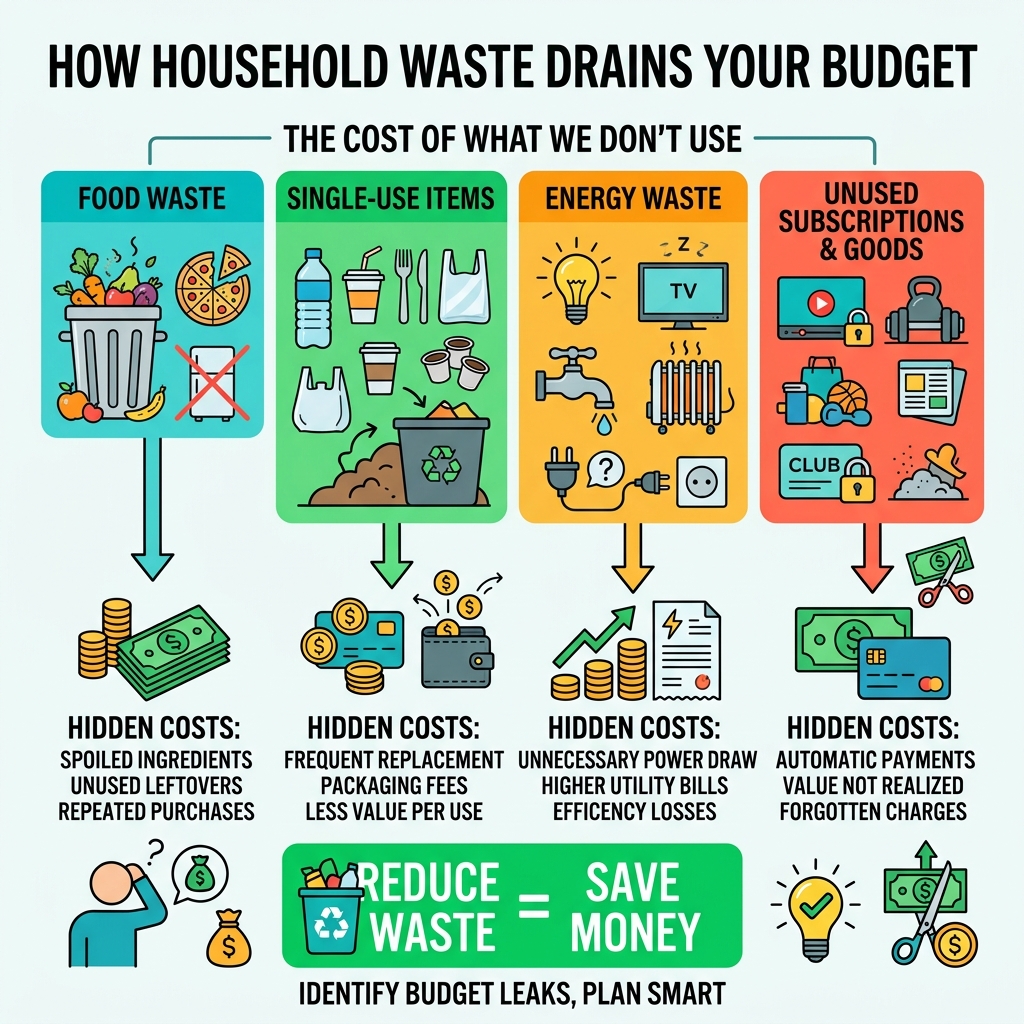
The Importance of Integrating Waste Reduction into Your Budget
When we talk about sustainability, we often think of solar panels or electric cars. But at FinanceZenX, we believe the most powerful sustainability tool is sitting right in your kitchen or on your smartphone: your budget. Integrating waste reduction into your financial planning isn’t just about being “green”; it’s about efficiency.
Every time we throw away a shriveled bag of spinach or pay for a streaming service we haven’t watched in three months, we are witnessing a budget leak. By using a reduce waste budget planner, we can identify these leaks and plug them. This process reduces our carbon footprint because fewer resources are needed to produce, transport, and dispose of the goods we buy. For more detailed strategies, you can read about reducing household waste effectively.
Food waste alone is a massive contributor to environmental degradation, accounting for roughly 8% of global emissions. When we plan our meals to reduce waste, we aren’t just saving the $1,500 that the average household loses annually to food waste—we’re also conserving the water and energy used to grow that food.
Why Your Reduce Waste Budget Planner Needs an Inventory Check
The foundation of any effective reduce waste budget planner is the inventory check. Most of us are guilty of “duplicate buying”—purchasing a jar of cumin or a box of pasta because we think we’re out, only to find three hidden in the back of the pantry later.
A proper audit involves three key areas:
- The Fridge: Check for items nearing their expiration. Use an “Eat Me First” box for produce that’s starting to look a bit sad.
- The Pantry: Look for staples like grains, beans, and spices. These are the building blocks of budget-friendly meals.
- The Freezer: The freezer is a “pause button” for food waste. Audit it to ensure you aren’t burying perfectly good proteins under bags of ice.
By knowing exactly what we have, we stop spending money on items we already own. This simple habit is one of the most effective zero-waste kitchen hacks you can implement today.
Combating Decision Fatigue with Grocery Templates
Have you ever walked into a grocery store hungry and without a list? It’s a recipe for budget disaster. Decision fatigue—the mental exhaustion from making too many choices—often leads to impulse buys of pre-packaged, high-waste convenience foods.
A structured grocery template helps us stay on track. By prioritizing dinner planning first, we eliminate the most stressful daily “what’s for dinner?” choice. We recommend stocking a “workable pantry” of staples, which allows for bulk buying of non-perishables. Buying in bulk reduces packaging waste and lowers the unit price, provided we actually use what we buy. Sticking to a list based on seasonal produce also ensures we get the freshest items at the lowest prices.
Digital vs. Physical: Choosing Your Sustainable Budgeting Tool
How we track our progress matters just as much as what we track. If we’re trying to reduce waste, we should consider the environmental impact of the planner itself.

Traditional planners often use plastic covers and non-recyclable bindings. However, there are eco-friendly alternatives. Stone paper is a material made from calcium carbonate and resin. It’s tree-free, waterproof, and has a 60% lower carbon footprint than traditional paper. If you prefer the tactile feel of a physical book, look for planners that are FSC-certified or made from 100% recycled materials.
Alternatively, digital tools are the ultimate low-waste option. Using a digital budget planner allows us to manage our finances without a single scrap of paper.
Leveraging Digital Tools for Your Reduce Waste Budget Planner
Digital planners offer several advantages beyond just saving trees. They allow for easy “planned vs. actual” comparisons, which are vital for spotting waste patterns. Many modern tools focus on privacy, keeping your data local to your browser rather than uploading it to a cloud server.
Exporting your data to a CSV file allows us to create custom charts and track progress over months or even years. This long-term view is essential for living a zero-waste lifestyle, as it helps you see the cumulative impact of small changes—like switching from bottled water to a filter or canceling that unused gym membership.
The Environmental Cost of Paper Budgeting
If you’re still on the fence about going digital, consider the statistics. It takes about 24 trees to produce just one ton of standard office paper. Worldwide, between 80,000 and 160,000 trees are cut down every single day to satisfy the paper industry’s demands.
Beyond deforestation, paper production is water-intensive. One ton of recycled paper saves 7,000 gallons of water and the equivalent of 165 gallons of gasoline. By moving our reduce waste budget planner to a digital format or using recycled materials, we are practicing the very sustainability we are preaching. For more on this transition, check out our guide on how to live a zero-waste lifestyle.
Advanced Strategies: From 50/30/20 to Community Waste Pricing
Once you’ve mastered the basics, you can apply more advanced financial frameworks to your waste reduction goals.
- The 50/30/20 Rule: Typically, this means 50% for needs, 30% for wants, and 20% for savings. In a waste-reducing budget, we look at the “wants” category through a sustainability lens. Do we “want” the convenience of single-use plastics, or do we “want” the long-term savings of reusables?
- Zero-Based Budgeting: This is where every dollar is assigned a job. If you have $50 left at the end of the month because you reduced your food waste, that $50 is intentionally moved to a savings goal or an eco-investment (like a compost bin).
- Pay-As-You-Throw (PAYT): Some communities treat trash like a utility. You pay for what you throw away. This creates a direct financial incentive to recycle and compost. You can use tools like the SMART BET Calculator to see how these programs impact community budgets and carbon footprints.
Traditional vs. Waste-Reducing Budgeting
| Feature | Traditional Budgeting | Waste-Reducing Budgeting |
|---|---|---|
| Primary Goal | Track cash flow | Eliminate resource waste |
| Food Strategy | Buy what’s on sale | Buy what you will eat (Inventory first) |
| Tool Choice | Any notebook or app | Low-impact digital or recycled tools |
| Tracking | Total spend per category | Planned vs. Actual + Waste metrics |
| Outcome | Financial awareness | Financial wellness + Eco-sustainability |
Step-by-Step Guide to Creating Your Own Reduce Waste Budget Planner
Ready to build your own? Follow these steps to create a system that actually works for your life.
Step 1: Define Your Waste-Reduction Categories
Standard budget categories like “Food” are too broad. To truly reduce waste, we need to get specific. Breakdown your categories into:
- Food Waste: Groceries that go unused.
- Energy Consumption: Phantom power and inefficient heating/cooling.
- Single-Use Plastics: Money spent on bottled water, baggies, and wraps. You can learn how to reduce plastic use at home to see where these costs hide.
- Subscription Cleanup: Digital waste—services you pay for but don’t use.
Step 2: Track Planned vs. Actual Spending
This is where the magic happens. At the start of the month, set a “Planned” amount for each category. Throughout the month, update your “Actual” spending twice a week.
If your “Actual” is consistently higher than your “Planned,” you’ve found a waste signal. For example, if you planned $100 for dining out but spent $200, ask yourself: Was this because I didn’t have a meal plan for busy nights? Use this variance analysis to course-correct for the following week.
Step 3: Repurpose and Optimize
A reduce waste budget planner should be flexible. If you have leftovers from Tuesday’s roasted chicken, don’t let them sit until they spoil. Plan to repurpose them into sandwiches, salads, or a soup on Wednesday.
Always have a “backup meal”—a simple, shelf-stable meal like pasta with jarred sauce—for those nights when your original plan falls through. This prevents the “emergency” takeout order that generates both financial and plastic waste.
Frequently Asked Questions about Waste-Reducing Budgeting
How does a waste-reducing budget differ from traditional tools?
A traditional budget focuses solely on the movement of money. A waste-reducing budget focuses on the utility of the items purchased. It incorporates inventory checks, spoilage tracking, and environmental impact metrics that traditional tools ignore. It’s about maximizing the value of every dollar spent by ensuring nothing goes to waste.
Can I use this planner for non-personal or IT budgets?
Absolutely. In fact, waste is a massive issue in the IT world. Gartner forecasts public cloud spending to reach over $723 billion in 2025. Much of this is “waste”—unused licenses, idle cloud resources, and duplicate software tools. Applying the same “Inventory and Audit” principles to an IT budget can save businesses millions. Just as emergency home repairs cost more than maintenance, emergency IT repairs cost 3 to 4 times more than planned maintenance.
What are the best free tools for waste-reduction planning?
There are several excellent free resources available:
- PlainBench: Great for simple, privacy-focused monthly budgeting with CSV exports.
- EPA SMART BET: Useful for understanding community-level waste pricing.
- Handy Chefdom: Offers a food waste cost calculator to help you see the literal dollar amount you’re throwing in the trash.
- Sure Sustainable: Provides planners specifically designed for waste reduction challenges.
Conclusion
At FinanceZenX, we believe that financial freedom and environmental stewardship are two sides of the same coin. By building a reduce waste budget planner, you aren’t just protecting your bank account; you’re protecting the planet for future generations.
It’s not about being perfect from day one. It’s about progress. Start with a simple inventory check this weekend, choose a low-impact tool that works for you, and begin tracking where your resources are actually going. Over time, these small, sustainable habits will compound into significant financial and ecological savings.
Explore more sustainable living tips and take control of your waste today. We are here to help you achieve a lifestyle that is as wealthy as it is wise.
