
Why Renewable Energy Cost Cutting Is Changing How the World Powers Itself
Renewable energy cost cutting is one of the biggest financial shifts of our lifetime — and it’s happening right now, faster than most people realize.
Here’s a quick snapshot of where things stand today:
| Energy Source | Average Cost (LCOE) | vs. Cheapest Fossil Fuel |
|---|---|---|
| Onshore Wind | $0.034/kWh | 53% cheaper |
| Solar PV | $0.043/kWh | 41% cheaper |
| Coal | ~$0.118/kWh | baseline comparison |
| Gas Peaker | ~$0.169/kWh | most expensive option |
Key facts at a glance:
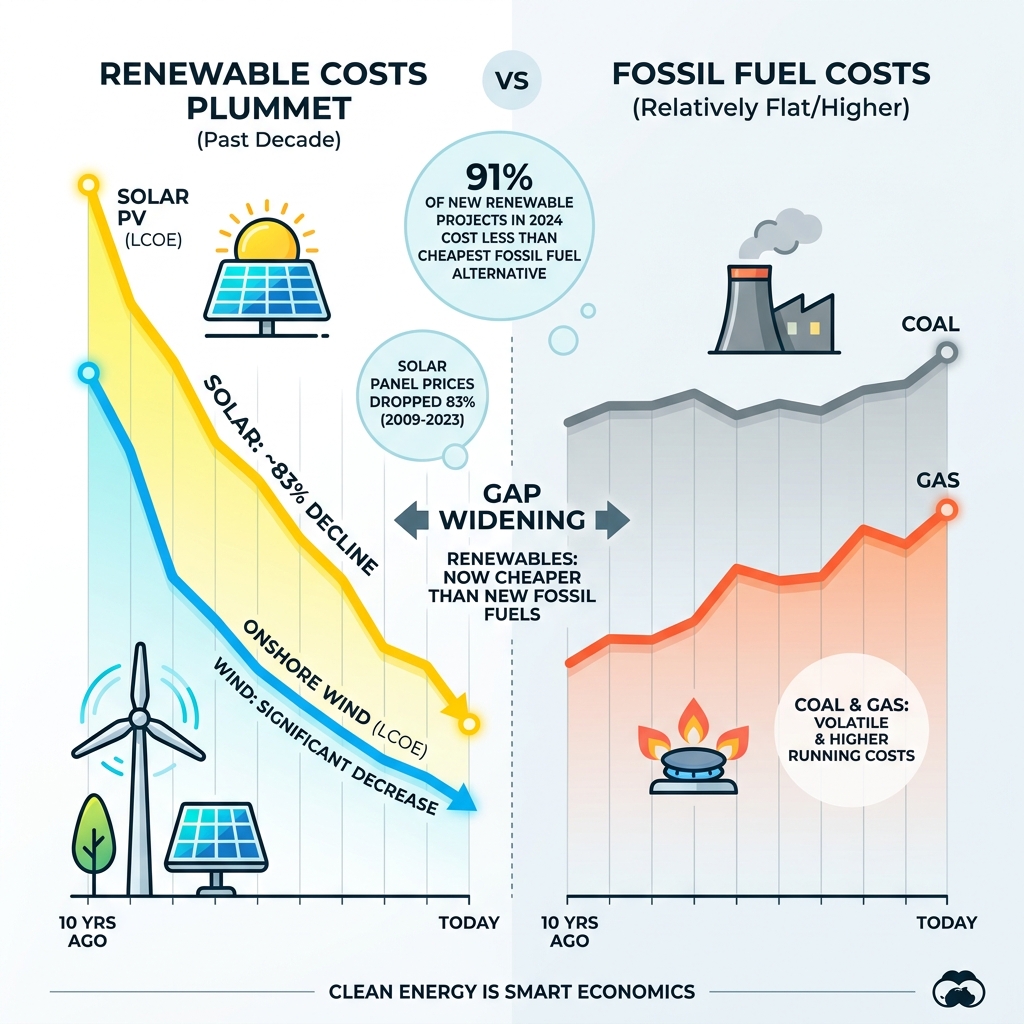
- 91% of new renewable projects built in 2024 cost less than any new fossil fuel alternative
- Renewables saved the world $467 billion in avoided fossil fuel costs in 2024 alone
- Solar panel prices dropped 83% between 2009 and 2023
- Battery storage costs fell 93% since 2010 — hitting a record low of $78/MWh in 2025
Not long ago, going green meant paying a premium. Solar and wind were the “expensive idealist” options. Fossil fuels were cheap, familiar, and deeply embedded in every power grid on the planet.
That world is gone.
Today, building a new solar or wind farm is cheaper than running an existing coal plant in most parts of the world. And the gap keeps widening. As UN Secretary-General António Guterres put it plainly: “Clean energy is smart economics — and the world is following the money.”
For eco-conscious households trying to reduce their footprint and their bills, this shift matters enormously. The same forces driving down utility-scale energy costs are starting to flow through to everyday consumers — through lower wholesale electricity prices, smarter grid technologies, and more affordable home solar options.
This guide breaks down exactly how renewable energy cost cutting works, what’s driving it, and — most importantly — what it means for your energy bills and your impact on the planet.
The Economic Shift: Why Renewables Are Winning the Cost War
We are witnessing a historic reversal in the energy sector. For decades, the “baseload” power provided by coal and gas was considered the gold standard for affordability. However, the latest data shows that the financial tide has completely turned. In 2024, a staggering 91% of all new utility-scale renewable capacity commissioned had lower costs than the cheapest fossil fuel alternative.

When we talk about renewable energy cost cutting, we aren’t just talking about a few cents here and there. We are seeing onshore wind costs drop to an average of USD 0.034/kWh and solar PV hitting USD 0.043/kWh. Compare that to the average cost of coal at $0.118/kWh, and it becomes clear why investors are fleeing fossil fuels. According to the Renewable Power Generation Costs in 2024 report, total installed costs for almost all renewable technologies fell by more than 10% between 2023 and 2024 alone.
Comparing LCOE: Renewables vs. Fossil Fuels
To understand these savings, we use a metric called the Levelized Cost of Energy (LCOE). Think of LCOE as the “all-in” price of a power plant over its entire life, including building it, running it, and fueling it.
The beauty of renewables is that their “fuel” — the sun and the wind — is free. Fossil fuels, on the other hand, are subject to wild price swings based on geopolitics and supply chain issues. In 2024, the existing fleet of renewables globally avoided an estimated USD 467 billion in fossil fuel costs. This is a massive win for global economic stability.
As noted in the press release regarding how 91% of New Renewable Projects Now Cheaper Than Fossil Fuels Alternatives, clean energy has reached price parity and beyond. It is no longer a matter of “if” renewables will take over, but how fast we can build the infrastructure to support them.
Strategic Drivers Behind Renewable Energy Cost Cutting
Why are these costs falling so fast? It isn’t magic; it’s a phenomenon known as Wright’s Law, or the “experience curve.” Essentially, every time we double the total amount of solar panels or wind turbines produced, the cost of making them drops by a consistent percentage.
Over the last decade, we’ve seen global cost declines of 2.5x to 4x for wind and solar. This is driven by economies of scale and supply chain optimization. When manufacturers produce millions of units, they find “micro-efficiencies” that add up to massive savings. We’ve also learned to standardize designs and share infrastructure, which are key 7 Strategies to Reduce Costs in Renewable Energy Projects.
Technological Innovations in Renewable Energy Cost Cutting
Beyond just making more of the same, we are getting smarter. New technologies are squeezing more power out of every ray of sunshine and every gust of wind:
- Bifacial Solar Panels: These panels have glass on both sides, allowing them to capture sunlight reflecting off the ground. This can improve energy generation by up to 11%.
- Single-Axis Trackers: These systems allow solar panels to follow the sun across the sky, significantly increasing daily output.
- Larger Wind Turbines: Modern turbines are taller with longer blades, allowing them to reach the more consistent, powerful winds found at higher altitudes.
- AI and Predictive Maintenance: Using artificial intelligence to predict when a part might fail allows operators to fix issues before they cause expensive downtime.
The report on The Power to Change Solar and Wind Cost Reduction Potential to 2025 highlights that these technical improvements, combined with lower operation and maintenance (O&M) costs, are the engines of the current price collapse.
Future Projections for Renewable Energy Cost Cutting
The future looks even brighter. Projections for 2030 and 2035 suggest that the downward trend is far from over. We expect to see a further 59% reduction in the cost of solar PV and a 26% reduction for onshore wind compared to 2015 levels.
According to the Wood Mackenzie Analysis: Renewable Energy to Reach Record-Low Global LCOE in 2025, certain regions are leading the charge. China, for instance, has recorded the world’s lowest national LCOE at just USD 27 per MWh. By 2060, some experts believe tracker-based solar costs could fall as low as USD 17/MWh.
How Clean Power Lowers Your Electricity Bills
You might be wondering: “If solar is so cheap, why is my bill still high?” It’s a fair question. While the generation of energy is cheaper, our grids are still catching up. However, renewables are already exerting downward pressure on wholesale prices through a mechanism called “merit-order dispatch.”
In electricity markets, power plants are “called upon” to provide energy based on their running costs. Because solar and wind have zero fuel costs, they bid into the market at $0. This pushes the most expensive, polluting fossil fuel plants (like “peaker” gas plants) to the back of the line. When renewables are plentiful, they set the “marginal price” for the entire market, lowering the cost for everyone.
To see how you can take advantage of these shifts at home, check out our guide on sustainable-strategies-for-lower-power-bills and discover more about slashing-utility-bills-with-mindful-eco-tips.
Residential Integration and Smart Savings
As we move toward a cleaner grid, the tools available to us as homeowners are becoming more affordable and effective. Integrating small-scale renewables and efficiency hacks is a cornerstone of a modern, eco-friendly financial plan.
We recommend starting with the basics. Simple practical-home-hacks-for-energy-efficiency like better insulation or LED lighting can reduce your demand, making it easier for renewables to cover your needs. For those ready to go further, sun-powered-living-solar-powered-devices-for-homes offers a way to generate your own “free” fuel.
Don’t forget the “brain” of your home: power-conservation-with-smart-plugs and smart thermostats can help you shift your energy use to times when renewable energy is most abundant and cheapest on the grid.
The Storage Revolution: Making Green Energy Reliable
The biggest criticism of renewables has always been: “What happens when the sun doesn’t shine or the wind doesn’t blow?” The answer is the storage revolution.
Battery storage costs have seen a staggering 93% decline since 2010. In 2025, battery storage costs hit a record low of USD 78/MWh for a four-hour project. This decline is largely thanks to the massive overcapacity in the electric vehicle (EV) battery market and better system designs. As reported by BloombergNEF, Battery Storage Costs Hit Record Lows, making storage-led balancing a viable alternative to fossil fuels.
Balancing the Grid with Hybrid Systems
We are seeing a surge in “hybrid” projects — solar-plus-storage. By co-locating batteries with solar farms, developers can “firm up” the power. They store excess energy during the sunny afternoon and release it during the evening peak when demand is highest.
This makes renewables incredibly reliable. In markets like California and Texas, solar-plus-storage is already meeting data center demand more cheaply than new gas plants. This shift from Volatility vs. Affordability: Globally, Renewables’ Cost Advantage Grows shows that we are moving away from the “swingy” prices of natural gas toward the stable, predictable costs of stored sunshine.
Overcoming Global Barriers to Cheaper Energy
While the news is mostly good, there are still hurdles to clear. The benefits of renewable energy cost cutting are not yet evenly distributed across the globe.
The primary challenge in developing countries isn’t the technology — it’s the cost of money. Financing a solar farm in Africa can come with a 12% interest rate due to perceived risks, while the same project in Europe might only face a 3.8% rate. This “risk premium” can make renewables more expensive upfront, even though they are cheaper over their lifetime. As noted by Around 90% of renewables cheaper than fossil fuels worldwide, addressing these financial barriers is essential for a fair global transition.
Strategies for Global Deployment
To speed things up, we need international cooperation. Strategies that are currently being implemented include:
- Government Guarantees: Using public funds to insure lenders against risk, which lowers interest rates for developers.
- Stable Policy Frameworks: Investors need to know that the rules won’t change halfway through a 20-year project.
- Grid Expansion: Investing in “energy highways” to move power from windy plains to crowded cities.
- Permitting Reform: In some places, it takes 4.5 years just to get the paperwork done for a solar farm. Streamlining this could reduce project costs by up to 30%.
Frequently Asked Questions about Renewable Energy Costs
Are renewables actually cheaper than coal and gas in 2025?
Yes! In almost every market globally, building new solar or wind is cheaper than building new coal or gas. In many cases, it is even cheaper to build new renewables than to continue operating existing coal plants. With onshore wind at $0.034/kWh and solar at $0.043/kWh, fossil fuels simply cannot compete on price.
How do falling battery prices affect my monthly power bill?
While you might not see a “battery line item” on your bill, falling storage costs allow utilities to use more cheap renewable energy and less expensive “peaker” gas. This stabilizes the wholesale price of electricity, which eventually flows through to consumer rates. Additionally, home battery systems are becoming more affordable, allowing you to store your own solar power for use at night.
What are the main risks that could stop renewable costs from falling?
Short-term risks include supply chain disruptions, geopolitical tensions that affect raw material prices (like lithium or copper), and rising interest rates. However, the long-term trend of “learning by doing” (Wright’s Law) suggests that as we build more, the costs will continue to decline despite these temporary bumps.
Conclusion
At FinanceZenX, we believe that your financial health and the health of our planet are deeply interconnected. The era of renewable energy cost cutting is a perfect example of this philosophy in action. By embracing clean energy, we aren’t just doing the “right thing” for the environment; we are making the smartest choice for our wallets.
The transition to a sustainable lifestyle doesn’t have to be expensive. In fact, as the data shows, it’s becoming the most affordable way to live. Whether you’re looking at the global LCOE metrics or just trying to figure out how to lower your own utility bills, the trend is clear: the future is green, and it’s on sale.
To continue your journey toward a more balanced and eco-friendly life, Learn more about sustainable living on a budget and join us in building a future where financial wellness and ecology go hand in hand.
