
The Real Math Behind Reusable Products (And What It Means for Your Wallet)
Reusable product cost analysis is the process of comparing the full lifetime cost of a reusable item against its single-use alternative — factoring in purchase price, maintenance, cleaning, and how many times you actually use it.
Here’s the short answer most people are looking for:
| Factor | Single-Use | Reusable |
|---|---|---|
| Upfront cost | Low | Higher |
| Cost per use | High (never drops) | Drops with every use |
| Break-even point | N/A | Typically 1–6 months for household items |
| Long-term savings | None | Significant |
| Hidden costs | Disposal, restocking | Cleaning, replacement, labor |
Key takeaways at a glance:
- Reusables almost always cost less per use over time — but only if you actually use them enough
- Break-even can happen in as little as 4–6 weeks for everyday items like paper towel replacements or cotton rounds
- Hidden costs (cleaning, water, labor, replacement rates) can slow or even erase savings if ignored
- For businesses and industrial operations, the savings can be dramatic — one automotive parts study found reusable packaging cut total costs by 61%
Most of us were taught to think about price tags, not lifetime cost. That $0.05 disposable cotton pad feels cheap. But when you’re buying 1,092 of them a year, you’re quietly spending over $230 — compared to roughly $44 over the same period with reusables.
That’s the gap reusable product cost analysis is designed to expose.
It’s not just about being eco-friendly. It’s about where your money actually goes — and whether a smarter upfront investment can free up hundreds of dollars a year.

Breaking Down the Reusable Product Cost Analysis
When we look at the sticker price of a reusable item, it’s easy to get “sticker shock.” A high-quality insulated cooler bag might cost $15, while a disposable plastic one is $0.50. At first glance, the disposable seems like the winner. However, a proper reusable product cost analysis looks far beyond the cash register.
To understand the true cost, we have to look at the Lifecycle Cost Analysis (LCCA). This involves categorizing expenses into several buckets:
1. Initial Acquisition
This is your upfront investment. For a business, this might include bulk-buying 2,000 plastic totes to replace 8,000 cardboard boxes. For a household, it’s buying your first set of everyday eco-sustainable products for daily use.
2. Maintenance and Labor
Reusables don’t just sit there; they need to be managed. This includes the labor to collect, sort, and move items. In an industrial setting, this might involve staff time to manage “reverse logistics”—the process of getting the packaging back to the start of the supply chain.
3. Water and Energy Usage
If you’re washing it, you’re paying for it. Research shows that for many reusables, cleaning accounts for nearly 90% of their lifecycle water consumption. Whether it’s a dishwasher at home or an industrial sanitation facility for a catering company, these utility costs must be factored into the per-use price.
4. Cleaning Chemicals and Consumables
Soap, detergent, and sanitizers add up. For example, in large-scale bioreactors used in biotech, the cost of cleaning chemicals and high-purity water is a major factor in determining whether to stay with reusable stainless steel or switch to single-use bags.
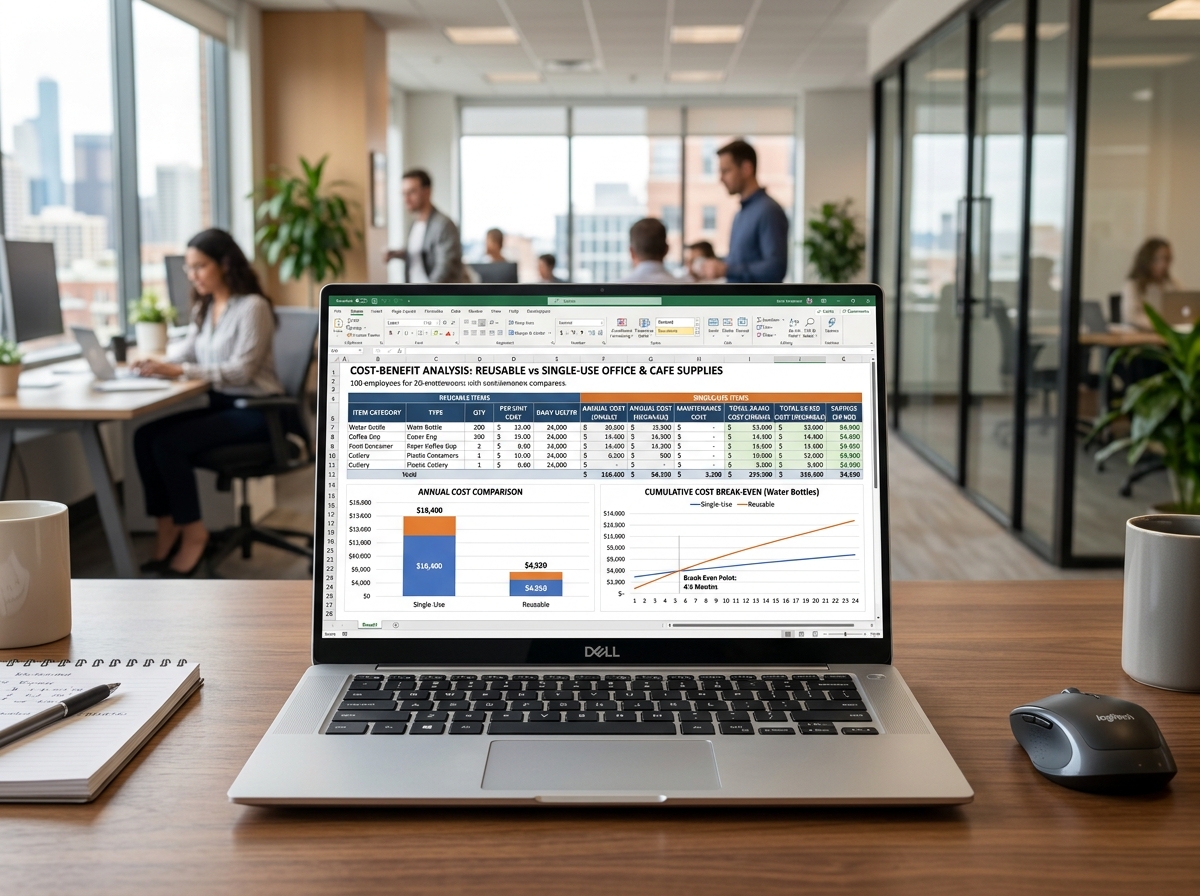
According to a Lifecycle Cost Analysis: Disposable vs. Reusable Cooler Bags, a reusable bag that lasts for 200 uses can bring the cost down to just 1 cent per use, whereas disposables stay at a fixed, higher rate.
| Cost Component | Single-Use (Disposable) | Reusable (Durable) |
|---|---|---|
| Purchase Price | $0.10 – $0.50 | $2.00 – $15.00 |
| Cleaning Labor | $0.00 | $0.01 – $0.05 per cycle |
| Utilities (Water/Heat) | $0.00 | $0.01 – $0.03 per cycle |
| Disposal Fees | $0.01 – $0.02 | $0.00 (until end of life) |
| Total Cost (100 Uses) | $10.00 – $50.00 | $4.00 – $23.00 |
Calculating the Break-Even Point for Reusables
The “Break-Even Point” is the magical moment where the higher initial investment of a reusable item finally pays for itself. To find this point, we look at several variables:
- Usage Frequency: How often do you use the item? A reusable coffee cup you use daily breaks even much faster than a reusable party platter you use twice a year.
- Replacement Rates: Nothing lasts forever. If you buy cheap reusable glassware but break 50% of it every year, your break-even point might never arrive.
- Amortization: This is just a fancy way of spreading the cost of the item over its expected life. If a $20 bag lasts 500 uses, you are “paying” 4 cents per use.
A great example of this math in action can be found in a study on Are Reusable Cotton Rounds Worth The Upfront Cost Versus Disposable Pads Long-term ROI. For the average user, the break-even point for cotton rounds is roughly 4.2 months. After that, every use is essentially “free” compared to buying new packs of disposables.
Reusable Product Cost Analysis for Household Items
In our homes, the savings are often small per day but massive per year.
- Cotton Rounds: As mentioned, switching can save over $200 over three years.
- Paper Towels: A family of four typically spends about $240 a year on paper towels. By switching to reusable cloths (which might cost $40 upfront), they can save nearly $200 in the first year alone.
- Cleaning Concentrates: Instead of buying a new plastic bottle of glass cleaner for $4, you can buy a glass bottle once and use concentrates that cost $1 per refill.
- Shopping Bags: We’ve seen that making the switch: reusable shopping bags reviewed can save the average consumer $15-$30 a year in bag fees, not to mention the durability benefits.
If you’re feeling crafty, you can even look into a guide to making reusable household items to bring your initial acquisition cost down to almost zero by upcycling old textiles.
Industrial Reusable Product Cost Analysis and Scale
In the business world, the scale of savings moves from “coffee money” to “new warehouse money.”
- Automotive Logistics: In a Thai automotive export study, switching to a multi-trip reverse logistics system for parts packaging reduced total packaging costs by 61% and waste by 68%. Assembly companies have found they can save roughly $125 per vehicle just by using reusable containers.
- Foodservice Packaging: A university cafeteria that switched to reusable containers saw a 30% annual reduction in waste. While there is a cost to washing those containers, the reduction in hauling fees and purchase costs usually results in a net gain. You can find more on this in the Cost-Benefit Analysis of Reusable vs. Single-Use Packaging.
- Bioreactors: In the biotech and cultivated meat industries, the choice is between single-use plastic bags and reusable stainless steel. Single-use systems have 50–66% lower upfront costs, but for large-scale operations (over 8,000 liters), reusables become more cost-effective after about 30 batches.
Hidden Costs and When Single-Use Wins
We want reusables to win every time, but as experts in reusable product cost analysis, we have to be honest: sometimes single-use is actually more cost-effective.
The “Hidden” Expenses of Going Reusable
- Sanitation Labor: This is often the biggest “gotcha.” For a reusable diaper service, for example, sanitation labor is the largest cash outflow. If you aren’t efficient with your cleaning process, the labor costs can eat your savings alive.
- Inventory Loss (Shrinkage): People lose things. In the restaurant industry, glassware and cutlery have an annual replacement rate of 50% to 100%. If your customers (or staff) accidentally throw away your “reusables,” you’re just buying very expensive disposables.
- Validation Costs: In industries like pharma or biotech, you have to prove a reusable container is clean. Validation can cost between £40,000 and £120,000 for reusable systems, compared to less than £8,000 for single-use.
- Transportation and Fuel: Reusables are usually heavier than single-use plastics. If you have to ship them long distances to be cleaned and returned, the fuel costs and carbon emissions from transport can outweigh the benefits.
A Cost–Benefit Model for Sustainable Product Reuse and Repurposing in Circular Remanufacturing highlights that if the “Remaining Useful Life” (RUL) of a product is too low, the cost to inspect and refurbish it can actually exceed the cost of a brand-new item.
There is also the “time cost.” If you are a busy professional and spending two hours a week washing and drying reusable cotton rounds, and you value your time at $30/hour, those rounds are costing you $60 a week in labor. For some, simple ideas to make DIY reusable bags at home are a fun hobby; for others, the time investment makes it a net financial loss.
Frequently Asked Questions about Reusable Savings
How do I calculate my own break-even point for a new reusable purchase?
To find your break-even point, use this simple formula: Upfront Cost of Reusable / (Cost of Single-Use per unit – Maintenance Cost of Reusable per unit).
For example, if a reusable coffee cup costs $20, a disposable cup costs $0.20, and it costs you $0.02 in soap/water to wash the reusable: $20 / ($0.20 – $0.02) = 111 uses to break even. If you drink one coffee a day, you’ll start saving money in about four months!
Which industries see the most significant savings from switching to reusables?
The automotive and grocery industries currently lead the pack. Automotive assembly relies on high-volume, predictable loops where containers can be easily returned. Grocery chains save thousands per store by switching from waxed cardboard boxes (which can’t be recycled) to reusable plastic crates for produce.
Are there environmental costs that should be factored into the economic analysis?
Absolutely. While not always a direct “cash” cost, many businesses now factor in “Carbon Pricing” or “Extended Producer Responsibility” (EPR) fees. Governments are increasingly charging companies for the waste they produce. By switching to reusables, companies can avoid these taxes, which makes the reusable product cost analysis look even better.
Conclusion
At FinanceZenX, we believe that integrating financial wellness with eco-friendly philosophies isn’t just a trend—it’s a long-term financial strategy. Whether you are a head of household looking to trim $500 off your annual budget or a logistics manager aiming to slash packaging spend by 60%, the math points in the same direction.
The transition to a circular economy requires looking past the initial price tag and understanding the full lifecycle of what we buy. While there are hidden costs like labor and sanitation to watch out for, the “Math of Reusables” generally favors the patient investor.
By choosing durable, high-quality items and maintaining them well, you aren’t just reducing waste; you’re building a more resilient personal or business economy. For more tips on how to balance your checkbook while saving the planet, check out our guide on sustainable living on a budget.
